

How to measure the performance of a single acting cylinder?
How to Measure the Performance of a Single Acting Cylinder
As a supplier of Single Acting Cylinder, understanding how to measure the performance of these cylinders is crucial. Single acting cylinders are widely used in various industries due to their simplicity and cost - effectiveness. They operate by applying hydraulic or pneumatic pressure to one side of the piston, and the return stroke is usually achieved through an external force such as gravity or a spring.
1. Force Output Measurement
The force output of a single acting cylinder is one of the most important performance indicators. The theoretical force generated by a single acting cylinder can be calculated using the formula (F = P\times A), where (F) is the force, (P) is the pressure applied to the piston, and (A) is the cross - sectional area of the piston.
To measure the actual force output, a load cell can be used. A load cell is a transducer that converts force into an electrical signal. When the cylinder extends and applies force to the load cell, the load cell measures the force and provides a corresponding output. This measured force can then be compared with the theoretical force. If there is a significant difference, it may indicate problems such as internal leakage, friction in the cylinder, or incorrect pressure supply.
For example, if the theoretical force of a single acting cylinder with a piston diameter of 50 mm and a pressure of 10 MPa is calculated as follows:
First, calculate the cross - sectional area (A=\frac{\pi d^{2}}{4}), where (d = 50mm=0.05m). So, (A=\frac{\pi\times(0.05)^{2}}{4}\approx0.00196m^{2}).
The theoretical force (F = P\times A=10\times10^{6}Pa\times0.00196m^{2}=19600N).
If the measured force using a load cell is only 15000 N, there may be some issues that need to be investigated.
2. Stroke Length Measurement
The stroke length of a single acting cylinder is the distance that the piston can travel from its fully retracted position to its fully extended position. This can be measured using a linear displacement sensor.
There are several types of linear displacement sensors available, such as potentiometric sensors, inductive sensors, and optical sensors. Potentiometric sensors work by changing the resistance as the piston moves, and the change in resistance can be converted into a displacement measurement. Inductive sensors use the principle of electromagnetic induction to detect the position of the piston. Optical sensors, on the other hand, use light to measure the displacement.
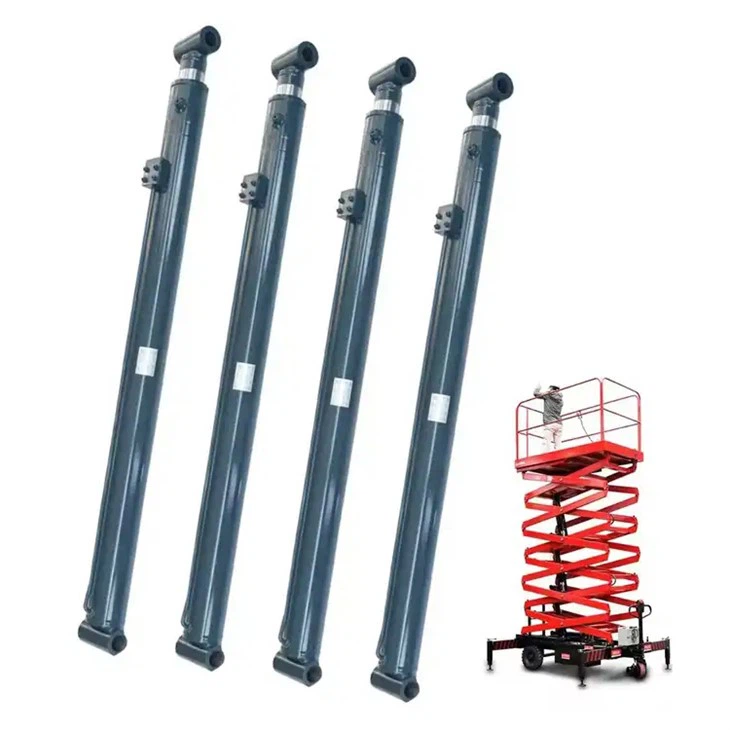

Accurate stroke length measurement is important because it determines the range of motion of the cylinder in a particular application. If the stroke length is shorter than specified, it may not be able to perform the required task. For instance, in a lifting application, if the stroke length is insufficient, the object may not be lifted to the desired height.
3. Speed of Operation
The speed of operation of a single acting cylinder is another key performance parameter. It is usually measured in terms of the extension and retraction speed. To measure the speed, a combination of a linear displacement sensor and a timer can be used.
The linear displacement sensor measures the distance traveled by the piston, and the timer records the time taken for the piston to travel that distance. The speed (v=\frac{s}{t}), where (s) is the displacement and (t) is the time.
Factors that can affect the speed of operation include the flow rate of the hydraulic or pneumatic fluid, the viscosity of the fluid, and the internal resistance of the cylinder. For example, if the flow rate of the hydraulic fluid is too low, the cylinder will extend or retract slowly.
4. Leakage Detection
Leakage is a common problem in single acting cylinders, and it can significantly affect the performance. There are two main types of leakage: internal leakage and external leakage.
Internal leakage occurs between the piston and the cylinder bore or between the rod and the gland. To detect internal leakage, a pressure - decay test can be used. In this test, the cylinder is pressurized to a certain level, and then the pressure source is isolated. The pressure in the cylinder is monitored over a period of time. If the pressure drops rapidly, it indicates internal leakage.
External leakage can be easily detected by visual inspection. Look for signs of fluid dripping or seeping from the cylinder. Leakage can lead to a loss of pressure, reduced force output, and environmental pollution. For example, in a hydraulic single acting cylinder, hydraulic fluid leakage can contaminate the working environment and cause damage to other components.
5. Seal Performance
The seals in a Single Acting Hydraulic Cylinder Seals play a crucial role in its performance. The performance of the seals can be evaluated by observing the leakage rate and the wear of the seals.
As mentioned above, a low leakage rate indicates good seal performance. In addition, the wear of the seals can be inspected during maintenance. If the seals are worn out, they may need to be replaced. Worn seals can cause internal and external leakage, and they can also increase the friction in the cylinder, reducing the overall efficiency.
6. Small Single Acting Hydraulic Cylinder Considerations
For Small Single Acting Hydraulic Cylinder, some additional factors need to be considered when measuring performance. Due to their small size, the measurement accuracy requirements are often higher.
The force output of small cylinders is relatively small, so more sensitive load cells are needed for accurate measurement. The stroke length and speed of small cylinders are also usually smaller, which requires more precise displacement sensors and timers.
In addition, small cylinders are more prone to problems such as clogging of the fluid passages. Therefore, the flow rate and pressure stability need to be carefully monitored to ensure proper operation.
Conclusion
Measuring the performance of a single acting cylinder is a comprehensive process that involves multiple parameters. By accurately measuring force output, stroke length, speed of operation, leakage, and seal performance, we can ensure that the cylinders meet the requirements of various applications.
As a supplier, we are committed to providing high - quality single acting cylinders. If you are interested in our products or have any questions about measuring the performance of single acting cylinders, please feel free to contact us for further discussion and potential procurement. We are always ready to offer you the best solutions and services.
References
- "Hydraulic and Pneumatic Systems" by John C. Palm III.
- "Fluid Power Technology" by F. Richard Turnquist.