

What is the efficiency of a piston motor?
As a supplier of piston motors, I've witnessed firsthand the critical role these components play in various industrial applications. Efficiency is a key factor that can significantly impact the performance and cost - effectiveness of any system using piston motors. In this blog, I'll delve into what the efficiency of a piston motor means, the factors affecting it, and how we, as a supplier, can offer high - efficiency solutions.
Understanding the Efficiency of a Piston Motor
Efficiency in a piston motor is essentially a measure of how well it converts the input energy into useful mechanical output energy. There are two main types of efficiency to consider: volumetric efficiency and mechanical efficiency.
Volumetric efficiency ($\eta_v$) is related to the ability of the piston motor to deliver the expected volume of fluid. It is defined as the ratio of the actual flow rate ($Q_{actual}$) of the fluid through the motor to the theoretical flow rate ($Q_{theoretical}$). Mathematically, $\eta_v=\frac{Q_{actual}}{Q_{theoretical}}$. The theoretical flow rate is calculated based on the displacement of the motor and the rotational speed. However, in real - world scenarios, there are always some internal leakages within the motor. These leakages can occur through clearances between the pistons and the cylinder walls, valve plates, and other components. Higher internal leakages result in a lower actual flow rate, thus reducing the volumetric efficiency.
Mechanical efficiency ($\eta_m$) is concerned with the conversion of the hydraulic energy into mechanical energy at the output shaft. It is the ratio of the actual mechanical power output ($P_{actual}$) to the theoretical mechanical power input ($P_{theoretical}$). The theoretical power input is calculated from the pressure difference across the motor and the flow rate. Friction losses are the main culprit for reducing mechanical efficiency. Friction can occur between moving parts such as pistons, bearings, and shafts. Additionally, viscous losses due to the fluid's resistance to flow also contribute to the reduction of mechanical efficiency.
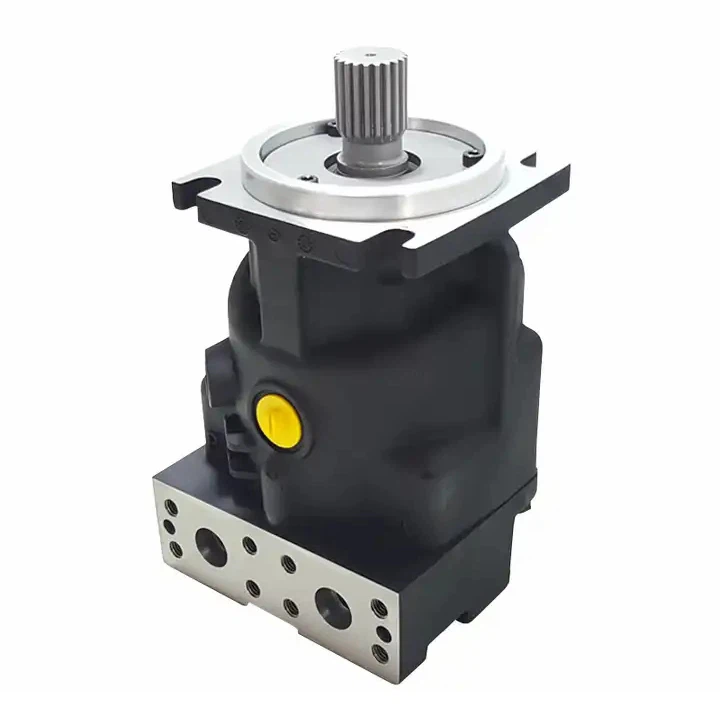

The overall efficiency ($\eta_{overall}$) of a piston motor is the product of volumetric efficiency and mechanical efficiency, i.e., $\eta_{overall}=\eta_v\times\eta_m$. A high - efficiency piston motor will have both high volumetric and mechanical efficiencies, which means it can convert a large proportion of the input hydraulic energy into useful mechanical work with minimal losses.
Factors Affecting the Efficiency of Piston Motors
Design and Manufacturing Quality
The design of a piston motor has a profound impact on its efficiency. For example, the shape and size of the pistons, the layout of the cylinders, and the design of the valve plates all play crucial roles. A well - designed piston motor will minimize internal leakages and friction losses. High - quality manufacturing processes are also essential. Precision machining of components ensures tight clearances, which reduces leakages. The use of high - quality materials can also enhance the durability and reduce friction. For instance, using advanced alloys for pistons and bearings can improve the mechanical efficiency of the motor.
Operating Conditions
The operating conditions of a piston motor can significantly affect its efficiency. Temperature is one of the important factors. At high temperatures, the viscosity of the hydraulic fluid decreases, which can increase internal leakages and reduce volumetric efficiency. On the other hand, at very low temperatures, the fluid's viscosity increases, leading to higher viscous losses and reduced mechanical efficiency.
The pressure and flow rate also matter. Operating a piston motor at its rated pressure and flow rate is ideal for achieving high efficiency. If the pressure is too high, it can cause excessive stress on the components, leading to increased wear and potential damage. If the flow rate is too low, the motor may not operate smoothly, and the efficiency will be compromised.
Maintenance
Regular maintenance is crucial for maintaining the efficiency of a piston motor. Over time, components can wear out, and contaminants can enter the hydraulic system. Worn - out pistons, seals, and bearings can increase internal leakages and friction. Contaminants in the hydraulic fluid can cause abrasion and blockages, further reducing the efficiency. By performing regular maintenance tasks such as changing the hydraulic fluid, replacing filters, and inspecting components, the efficiency of the piston motor can be maintained at a high level.
Types of Piston Motors and Their Efficiency Characteristics
Radial Piston Hydraulic Motor
Radial piston hydraulic motors Radial Piston Hydraulic Motor are known for their high torque output at low speeds. They typically have a relatively high volumetric efficiency because of their design, which allows for a large displacement per revolution. The pistons are arranged radially around a central shaft, and the fluid pressure acts on the pistons to generate torque. However, their mechanical efficiency can be affected by the relatively large number of moving parts, which can result in higher friction losses.
Axial Piston Motor
Axial piston motors Axial Piston Motor are widely used in high - speed applications. They have a compact design and can achieve high rotational speeds. Axial piston motors generally have good mechanical efficiency due to their streamlined design and fewer moving parts compared to radial piston motors. However, their volumetric efficiency can be affected by the high - speed operation, which may lead to increased internal leakages.
Hydraulic Piston Motor
Hydraulic piston motors Hydraulic Piston Motor is a general term that encompasses both radial and axial piston motors. The efficiency of a hydraulic piston motor depends on its specific type and design. Some hydraulic piston motors are designed for high - efficiency operation in specific applications, such as mobile equipment or industrial machinery.
Our Offerings as a Piston Motor Supplier
As a piston motor supplier, we understand the importance of efficiency in our products. We offer a wide range of piston motors, including radial and axial piston motors, with high - efficiency designs. Our motors are manufactured using state - of - the - art technology and high - quality materials to ensure minimal internal leakages and friction losses.
We also provide comprehensive technical support to our customers. Our team of experts can help customers select the most suitable piston motor for their specific applications based on factors such as operating conditions, required torque, and speed. We can also offer advice on maintenance and troubleshooting to ensure that the motors operate at their peak efficiency throughout their service life.
Conclusion
The efficiency of a piston motor is a complex concept that is influenced by various factors, including design, operating conditions, and maintenance. Understanding these factors is crucial for both users and suppliers of piston motors. As a piston motor supplier, we are committed to providing high - efficiency products and excellent service to our customers. If you are in the market for a piston motor and want to ensure optimal efficiency for your application, we invite you to contact us for a detailed discussion. Our team is ready to assist you in finding the best solution for your needs.
References
- Thoma, D. J. (2004). Hydraulic Pumps and Motors: Fundamentals, Selection, and Application. Marcel Dekker.
- Ivantysyn, J., & Ivantysynova, M. (2001). Fluid Power Systems. Springer.
- Merritt, H. E. (1967). Hydraulic Control Systems. John Wiley & Sons.