

What is the efficiency of a fuel gear pump?
Hey there! As a supplier of Fuel Gear Pumps, I often get asked about the efficiency of these nifty little devices. So, let's dive right in and break down what the efficiency of a fuel gear pump really means.
First off, what's a fuel gear pump? Well, it's a type of positive displacement pump. In simple terms, it moves a fixed amount of fluid (in this case, fuel) with each revolution of its gears. These pumps are widely used in various applications, from automotive engines to industrial machinery, because they're reliable, durable, and can handle different types of fuels.
Now, when we talk about the efficiency of a fuel gear pump, we're mainly looking at two types: volumetric efficiency and mechanical efficiency.
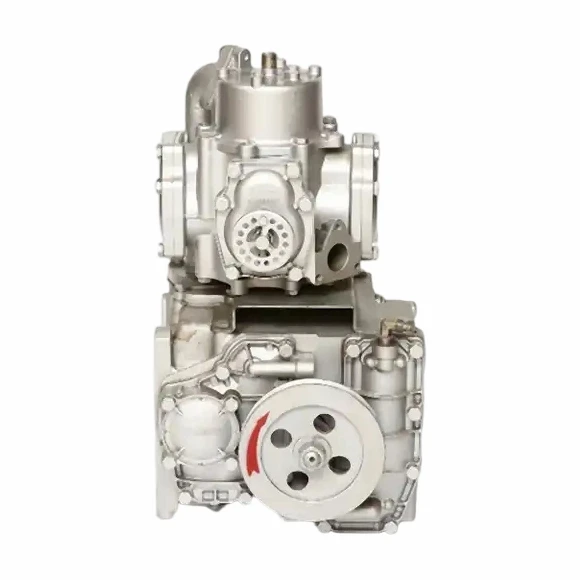

Volumetric efficiency is all about how well the pump can move the fuel. It's the ratio of the actual volume of fuel delivered by the pump to the theoretical volume it should deliver. You see, in an ideal world, a pump would move every drop of fuel that it's supposed to. But in reality, there are always some losses. These losses can be due to things like leakage between the gears and the pump housing, or even the compression of the fuel itself.
For example, if a fuel gear pump is designed to deliver 100 liters of fuel per minute, but it only manages to deliver 90 liters, its volumetric efficiency would be 90%. Higher volumetric efficiency means the pump is better at moving the fuel, which is super important for applications where a precise amount of fuel is needed, like in an engine.
Mechanical efficiency, on the other hand, is about how well the pump converts the input power (usually from an engine or an electric motor) into useful work. There are always some frictional losses in a pump. The gears have to rotate against each other and against the pump housing, and there are also losses in the bearings and seals.
Let's say you're using an electric motor to drive the fuel gear pump, and the motor is supplying 100 watts of power. But due to all these frictional losses, the pump is only able to use 80 watts to actually move the fuel. In this case, the mechanical efficiency of the pump would be 80%. A higher mechanical efficiency means less power is wasted as heat, which is not only better for the environment but also for the overall performance of the system.
So, how do we improve the efficiency of a fuel gear pump? Well, there are a few ways.
One of the most important factors is the design of the pump. High - quality materials and precise manufacturing can make a huge difference. For instance, using gears with a smooth surface finish can reduce friction, which in turn improves mechanical efficiency. And a well - designed pump housing can minimize leakage, boosting volumetric efficiency.
Proper maintenance is also key. Regularly checking and replacing worn - out parts like seals and bearings can prevent excessive leakage and friction. Keeping the pump clean and free from debris can also ensure that it operates at its best.
Another thing to consider is the operating conditions. Fuel gear pumps are designed to work within a certain range of pressures and temperatures. If the pump is operated outside of these ranges, its efficiency can drop significantly. For example, if the fuel is too hot, it can become less viscous, which can increase leakage and reduce volumetric efficiency.
Now, I'd like to mention some related products that we offer. If you're interested in different types of gear pumps, we have the Tandem Gear Pump. It's a great option for applications where you need a higher flow rate or more complex pumping arrangements. And for those in the food or pharmaceutical industries, we also have the Sanitary Gear Pump, which is designed to meet strict hygiene standards. Of course, our Fuel Gear Pump is our specialty, and we're confident in its efficiency and reliability.
If you're in the market for a fuel gear pump or any of our other products, we'd love to hear from you. Whether you're an automotive manufacturer looking for a reliable fuel delivery solution or an industrial company in need of a high - performance pump, we can help. Contact us to start a discussion about your specific requirements. We can provide you with detailed information about our products, including their efficiency ratings, and work with you to find the best pump for your application.
In conclusion, understanding the efficiency of a fuel gear pump is crucial for getting the most out of your system. By considering factors like design, maintenance, and operating conditions, you can ensure that your pump operates at peak efficiency. And if you have any questions or need further assistance, don't hesitate to reach out.
References
- "Pump Handbook" by Igor J. Karassik et al.
- Various industry whitepapers on positive displacement pumps.